
AG135FPJ4FRA (新製品)
車載用 Nチャネル 100V 300A, TOLG, パワーMOSFET
AG135FPJ4FRA (新製品)
車載用 Nチャネル 100V 300A, TOLG, パワーMOSFET
AG135FPJ4FRAはAEC-Q101に準拠した車載グレードのMOSFETです。車載システム用途に最適です。

主な仕様
特性:
Package Code
TOLG
Number of terminal
9
Polarity
N
Drain-Source Voltage VDSS[V]
100
Drain Current ID[A]
500
RDS(on)[Ω] VGS=6V(Typ)
0.00131
RDS(on)[Ω] VGS=10V(Typ)
0.00102
RDS(on)[Ω] VGS=Drive(Typ)
0.00131
Total gate charge Qg[nC]
120
Power Dissipation (PD)[W]
750
Drive Voltage[V]
6
trr (Typ.)[ns]
105
Mounting Style
Surface mount
Storage Temperature (Min)[℃]
-55
Storage Temperature (Max)[℃]
175
Package Size [mm]
11.7x9.9 (t=2.4)
Common Standard
AEC-Q101 (Automotive Grade)
特長:
- 低オン抵抗
- 鉛フリー対応済、RoHS準拠
- 100%アバランシェ耐量測定済
- AEC-Q101準拠
リファレンスデザイン / アプリケーション評価キット
-
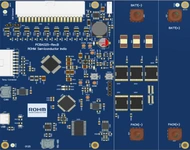
- Reference Design - REF68008
- 産業機器向け 16セルBMS評価プラットフォーム
This Battery Management System (BMS) platform provides detailed specifications for an industrial-grade lithium-ion battery monitoring and protection solution. It is designed to support reliable operation in demanding industrial energy storage and power backup applications.
The BMS evaluation platform serves as a reference design for assessing a multi-cell battery monitoring system utilizing ROHM’s ML5238 16-cell Analog Front End (AFE) in combination with the LAPIS ML63Q8057 microcontroller. The system enables accurate cell voltage measurement, current sensing, temperature monitoring, cell balancing, state-of-charge estimation, and fault detection, forming a complete solution for industrial battery packs.
This evaluation kit integrates the core functional blocks required for BMS operation, including the monitoring circuitry, control firmware, sensing interfaces, non-volatile memory, and PC communication interface. The design is optimized for robustness, measurement accuracy, and long-term reliability, making it suitable for industrial energy storage systems, uninterruptible power supplies (UPS), e-mobility auxiliary systems, and stationary battery applications.
The reference design includes comprehensive technical resources such as firmware architecture documentation, communication protocol definitions, memory maps, and configuration guidelines. It features a fully functional BMS firmware implementation optimized for industrial environments, supporting protection mechanisms, data logging, diagnostics, and seamless interfacing with a host PC or supervisory controller.
Users are encouraged to explore the advanced monitoring, protection, and diagnostic capabilities of this BMS evaluation platform and consider its integration or customization for their industrial battery management and energy storage development projects.
