
BD9G101G
降圧スイッチングレギュレータ パワーMOSFET 内蔵タイプ
BD9G101G
降圧スイッチングレギュレータ パワーMOSFET 内蔵タイプ
BD9G101G は高入力電圧42V に対応したパワーMOSFET 内蔵の降圧スイッチングレギュレータです。SOT23 の小型パッケージながら最大出力電流0.5A を供給することが可能です。また1.5MHz の高周波動作により小型コイルの使用を可能とし、電流モードによる位相補償素子の内蔵化によって機器の小型化を実現しています。

主な仕様
特性:
ch
1
Integrated FET / Controller
Integrated FET
Topology
Buck
Synchronous / Nonsynchronous
Non-synchronous
Vin1(Min.)[V]
6
Vin1(Max.)[V]
42
Vout1(Min.)[V]
1
Vout1(Max.)[V]
29.4
Iout1(Max.)[A]
0.5
SW frequency setting (Max.)[MHz]
1.7
EN
Yes
Operating Temperature (Min.)[°C]
-40
Operating Temperature (Max.)[°C]
105
Package Size [mm]
2.9x2.8 (t=1.25)
特長:
・ 高耐圧で広い入力電圧範囲(VCC=6V-42V)・ 45V/800mΩ Power MOSFET 内蔵
・ 高周波動作1.5MHz
・ 基準電圧( 0.75V±1.5%)回路内蔵
・ 位相補償回路内蔵
・ 過電流保護(OCP)、低入力誤動作防止(UVLO)、温度保護回路(TSD)等保護機能搭載
・ スタンバイ機能(ISC=0uA)
・ 小型SOT-23 パッケージ(SSOP6)
リファレンスデザイン / アプリケーション評価キット
-
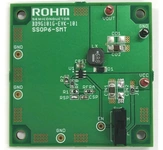
- Evaluation Board - BD9G101G-EVK-101
This evaluation board has been specifically developed to evaluate the BD9G101G non-synchronous buck DC/DC converter with integrated 45V/800mΩ power MOSFET. Features include wide input (6V to 42V) and output (1V to VCC x 0.7V) voltage ranges and a switching frequency of 1.5MHz.
-
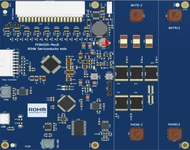
- Reference Design - REF68008
- 産業機器向け 16セルBMS評価プラットフォーム
This Battery Management System (BMS) platform provides detailed specifications for an industrial-grade lithium-ion battery monitoring and protection solution. It is designed to support reliable operation in demanding industrial energy storage and power backup applications.
The BMS evaluation platform serves as a reference design for assessing a multi-cell battery monitoring system utilizing ROHM’s ML5238 16-cell Analog Front End (AFE) in combination with the LAPIS ML63Q8057 microcontroller. The system enables accurate cell voltage measurement, current sensing, temperature monitoring, cell balancing, state-of-charge estimation, and fault detection, forming a complete solution for industrial battery packs.
This evaluation kit integrates the core functional blocks required for BMS operation, including the monitoring circuitry, control firmware, sensing interfaces, non-volatile memory, and PC communication interface. The design is optimized for robustness, measurement accuracy, and long-term reliability, making it suitable for industrial energy storage systems, uninterruptible power supplies (UPS), e-mobility auxiliary systems, and stationary battery applications.
The reference design includes comprehensive technical resources such as firmware architecture documentation, communication protocol definitions, memory maps, and configuration guidelines. It features a fully functional BMS firmware implementation optimized for industrial environments, supporting protection mechanisms, data logging, diagnostics, and seamless interfacing with a host PC or supervisory controller.
Users are encouraged to explore the advanced monitoring, protection, and diagnostic capabilities of this BMS evaluation platform and consider its integration or customization for their industrial battery management and energy storage development projects.
